With their capacity for autonomous problem-solving, flexible workflows, and scalability, artificial intelligence (AI) agents are poised to revolutionise business processes. However, creating better models isn’t the true challenge. In addition to having access to tools and data, agents must be able to exchange information between systems and make their outputs usable by other services, including other agents. This is an issue with data interoperability and infrastructure rather than AI. It necessitates an event-driven architecture (EDA) driven by data streams rather than merely piecing together sequences of instructions.
Agentic AI’s Ascent
Even though AI has advanced significantly, rigid processes and even large language models (LLMs) are reaching their limits.
Despite being trained on a larger quantity of data, Google’s Gemini is allegedly falling short of internal expectations. OpenAI and its next-generation Orion model have reported similar outcomes.
Marc Benioff, CEO of Salesforce, has stated that the capabilities of LLMs have hit their limit on The Wall Street Journal’s “Future of Everything” podcast. Instead of models like GPT-4, he thinks autonomous agents—systems with the ability to reason, adapt, and act on their own—are the way of the future.
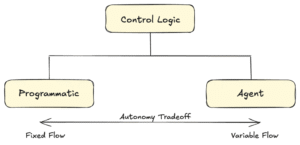
Workflows that are dynamic and context-driven are something new that agents provide. Agentic systems, in contrast to predefined workflows, determine the next course of action based on the current circumstances. Because of this, they are perfect for solving the types of unexpected, interrelated issues that modern organisations deal with.
Agents reverse the logic of traditional control.
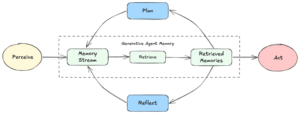
Agents employ LLMs to guide judgements rather than strict programming mandating every action. They have dynamic reasoning, tool use, and memory access. Agents are significantly more powerful than anything based on fixed logic because of their flexibility, which enables workflows that change in real time.
The Difficulties of Intelligent Agent Scaling
Easy access to and sharing of data is essential for scaling agents, whether they are a single agent or a cooperative system. To make choices and take action, agents must obtain information from a variety of sources, including other agents, tools, and external systems.
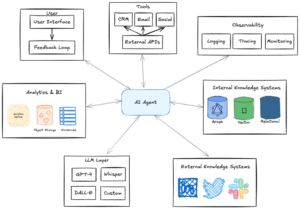
It is a distributed systems challenge to connect agents to the resources and information they require. The difficulties of building microservices, where components must effectively interact without causing bottlenecks or strict dependencies, are reflected in this complexity.
Agents must interact effectively and make sure that their outputs are beneficial to the larger system, just as microservices are. Additionally, their outputs should integrate with other crucial systems, such as data warehouses, customer relationship management (CRM) platforms, customer data platforms (CDPs), and customer success platforms, just like any other service.
An Overview of Event-Driven Architectures
Software systems were monoliths in the beginning. Everything was housed in a single, cohesive codebase. Monoliths were easy to construct, but as they expanded, they became a nightmare.
Scaling was a blunt tool: even if just one component required it, the entire program had to be scaled. This inefficiency resulted in brittle designs that were unable to accommodate expansion and bloated systems.
Microservices altered this.
Teams might grow and upgrade individual components of applications without affecting the entire system by dividing them into smaller, independently deployable components. However, this presented a new problem: How can these smaller services efficiently connect?
A massive jumble of interdependencies results from connecting services via direct RPC or API calls. All nodes in the connected route are affected if one service goes down.
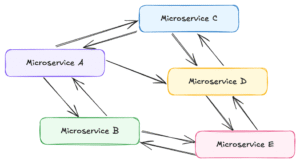
EDA resolved the issue.
EDA allows components to interact asynchronously using events rather than tightly linked, synchronous communication. Services respond to events in real time rather than waiting on one another.
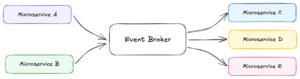
This approach made systems more resilient and adaptable, allowing them to handle the complexity of modern workflows. It wasn’t just a technical breakthrough; it was a survival strategy for systems under pressure.
The Early Social Giants’ Ascent and Decline
Scalable design is crucial, as seen by the emergence and failure of early social networks like Friendster. Early on, Friendster amassed enormous user numbers, but its systems were unable to meet the demand. Users left the platform due to performance problems, and it eventually collapsed.
Conversely, Facebook’s success may be attributed to both its features and its investments in scalable infrastructure. It ascended to dominance rather than collapsing under the weight of success.
With AI agents, we run the possibility of witnessing a similar tale unfold today.
Agents will proliferate and be adopted quickly, much like early social networks. Developing agents is insufficient. The true challenge is whether your architecture can manage the intricacy of multi-agent cooperation, tool integrations, and dispersed data. Like the early fatalities of social media, your agent stack might collapse without the proper foundation.
The Event of the Future-Agents Driven
The future of AI isn’t just about building smarter agents. It’s about creating systems that can evolve and scale as the technology advances. With the AI stack and underlying models changing rapidly, rigid designs quickly become barriers to innovation. To keep pace, we need architectures that prioritise flexibility, adaptability, and seamless integration. EDA is the foundation for this future, as it enables agents to thrive in dynamic environments while remaining resilient and scalable. Agents as Microservices With Informational Dependencies Agents are similar to microservices: They’re autonomous, decoupled, and capable of handling tasks independently. But agents go further. While microservices typically process discrete operations, agents rely on shared, context-rich information to reason, make decisions, and collaborate. This creates unique demands for managing dependencies and ensuring real-time data flows.
For example, an agent may retrieve client data from a CRM, analyse live analytics, and use external tools, all while exchanging changes with other agents. These interactions necessitate a system in which agents may function autonomously while still exchanging important information freely.
EDA addresses this issue by serving as a “central nervous system” for data. It enables agents to broadcast events asynchronously, ensuring that information flows flexibly while avoiding rigid dependencies. This decoupling enables agents to act autonomously while smoothly integrating into larger workflows and systems.
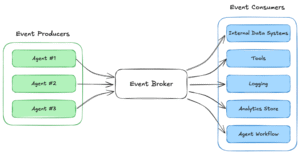
Decoupling While Keeping Context Intact
Building flexible systems does not need to compromise context. Traditional, tightly connected architectures can constrain processes to specific pipelines or technologies, requiring teams to overcome bottlenecks and dependencies. Changes in one element of the stack can ripple effects throughout the system, slowing down innovation and scaling efforts.
EDA eliminates these restrictions. EDA decouples workflows and enables asynchronous communication, allowing distinct portions of the stack—agents, data sources, tools, and application layers—to perform independently.
Take today’s AI stack as an example. Machine learning operations (MLOps) teams oversee pipelines such as retrieval-augmented generation (RAG), while data scientists choose models and application developers create the frontend and backend. A closely tied design puts all of these teams into needless interdependence, reducing delivery and making it more difficult to change when new tools and approaches arise.
In contrast, an event-driven system ensures that workflows stay loosely coupled, allowing each team to innovate independently.
Application layers don’t need to understand the AI’s internals; they simply consume results when needed. This decoupling also ensures that AI insights don’t remain siloed. Outputs from agents can seamlessly integrate into CRMs, CDPs, analytics tools, and more to create a unified, adaptable ecosystem.
Scaling Agents Using Event-Driven Architecture
EDA is the backbone of this transition to agentic systems. Its ability to decouple workflows while enabling real-time communication ensures that agents can operate efficiently at scale. As discussed here, platforms such as Apache Kafka® exemplify the advantages of EDA in an agent-driven system: Horizontal Scalability: Kafka’s distributed design supports the addition of new agents or consumers without bottlenecks, ensuring that the system grows effortlessly. Low Latency: Real-time event processing enables agents to respond instantly to changes, ensuring fast and reliable workflows. Loose Coupling: By communicating through Kafka topics rather than direct dependencies, agents remain independent and scalable. Event Persistence: Durable message storage guarantees that no data is lost in transit, which is critical for high-reliability workflows.
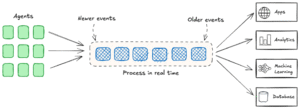
Data streaming enables the continuous flow of data throughout a business. The central nervous system acts as the unified backbone for real-time data flow, seamlessly connecting disparate systems, applications, and data sources to enable efficient agent communication and decision-making. This architecture is a natural fit for frameworks such as Anthropic’s Model Context Protocol (MCP). MCP provides a universal standard for integrating AI systems with external tools, data sources, and applications, ensuring secure and seamless access to up-to-date information. By simplifying these connections, MCP reduces development effort while enabling context-aware decision-making.
EDA addresses many of the challenges that MCP aims to solve. MCP requires seamless access to diverse data sources, real-time responsiveness, and scalability to support complex multi-agent workflows. By decoupling systems and enabling asynchronous communication, EDA simplifies integration and ensures that agents can consume and produce events without rigid dependencies.
Event-Driven Agents Will Define the Future of AI
The AI landscape is evolving rapidly, and architectures must evolve with it. And businesses are ready. A Forum Ventures survey found that 48% of senior IT leaders are prepared to integrate AI agents into operations, with 33% saying they’re very prepared. This shows a clear demand for systems that can scale and handle complexity. EDA is the key to building agent systems that are flexible, resilient, and scalable. It decouples components, enables real-time workflows, and ensures that agents can integrate seamlessly into broader ecosystems. Those who adopt EDA won’t just survive—they’ll gain a competitive edge in this new wave of AI innovation. The rest? They risk being left behind, casualties of their own inability to scale.