AI has been shown to create words, identify faces, and recommend what to watch next. However, it didn’t end there. Initially, machines operated according to predetermined rules. Nothing to learn. No understanding. Just basic reasoning. That marked the beginning of artificial intelligence.
Every level of AI reveals more as time goes on. Your AI starts to gather up knowledge. Next, make a prediction. and then produce something truly remarkable. 65% of businesses utilise AI to transform their operations, according to McKinsey. This is nearly twice the amount from the previous year.
The seven phases of AI development will be discussed in this article. These stages of AI demonstrate how robots go from simple orders to far more sophisticated ones. And it matters how you fit within that narrative.
What Are AI’s Stages?
The development of AI from basic rule-based systems to more sophisticated kinds of intelligence is explained by the phases of AI. Each level shows how AI has evolved in terms of its capacity to process information, learn from historical data, and advance towards intelligence comparable to or even greater than that of humans.
These phases of AI development provide us with a framework for comprehending AI’s current state, its evolution over time, and its potential future.
7 Phases of AI
You can see how AI develops throughout time by looking at its phases. You begin with simple, rule-based systems. Then, when AI acquires new abilities, you advance through each level. It starts to think. It begins to resolve challenging issues. This framework enables you to comprehend the current state of AI. These many phases of AI development also indicate what lies ahead.
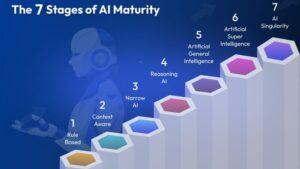
Step 1: Systems Based on Rules
AI steps start at this point. You observe basic machines that adhere to rigid logic and are rule-based. Every action is based on an IF-THEN rule. There’s no place for uncertainty. There is no space for alteration.
These systems are not cognitive. Only programmers’ instructions are followed by them. The system may malfunction if you alter the input. It is unable to adjust. Many refer to it as fragile because of this.
However, this step is really important. These rules served as the foundation for early expert systems. For instance, researchers developed MYCIN, a medical expert system, in the 1970s. It demonstrated how rule-based AI may support decision-making. The system recommended therapies for bacterial infections when doctors input the patient’s symptoms. However, it did not react when new circumstances emerged that defied its reasoning.
This phase of AI development is the first significant attempt to replicate human reasoning. It moves slowly. It is inflexible. However, it lays the groundwork for all that follows.
Stage 2: Retention and Context Awareness
You get beyond static answers at this stage of AI. AI no longer responds independently. It begins to retain short-term information and applies it to improve decision-making.
This modification gives it more depth. Over time, your system starts to identify trends. It watches, picks up some quick knowledge, and makes adjustments. This is referred to as limited memory AI in machine learning. When making judgments, it enables AI to take current occurrences into account. In this phase of AI research, these systems not only follow commands but also learn from past data to generate replies that like those of a person.
For instance, self-driving automobiles make choices in real time using a small amount of memory. They monitor pedestrian activity, traffic lights, and surrounding automobiles. This goes beyond simply responding. It is changing according to the situation. Recent user behaviour is another factor used by modern recommendation systems. They modify recommendations depending on your recent actions as well as who you are.
The phases of AI have advanced significantly with this step. It forces machines to develop greater situational awareness. For a little moment, more like us.
Stage 3: AI Specific to a Domain
Artificial Narrow Intelligence (ANI) is the present level of AI, in which your robots are proficient in just one particular activity. At this moment, your AI becomes incredibly talented, but only in one area. It is really good at one thing, but it does not comprehend the universe as its whole. AI is trained for a certain task. And in that regard, technology frequently performs better than people.
You start to see significant advancements in:
Recognition of faces
Diagnostics in medicine
Customer support Chatbots
AI is solving problems more quickly and precisely than ever before, yet it does not think like a human. At these AI levels, your AI system analyses massive amounts of data, recognises patterns, and makes intelligent choices within its specific fields.
A medical AI that scans X-rays, for instance. It has no idea what a hospital looks like or what a human is. However, it is more adept than many physicians in identifying illness symptoms. It learnt what to search for after being trained on thousands of photos. It does this one duty with accuracy.
Your AI isn’t yet all-purpose. It is unable to switch between tasks. However, it becomes an effective tool inside its focal region. This is the point at which AI starts to feel necessary, and you start to appreciate its practical benefits.
Stage 4: Theory of Mind
Your AI starts to do more than just analyse data at this point in the seven phases of AI development. It begins to realise that humans have feelings, ideas, and objectives. The system strives to comprehend human behaviour and the reasons behind it.
You see AI attempting to decipher intent. It examines behavioural patterns, tone, and expression. It does more than simply react to your words. However, it attempts to interpret your meaning. A philosophy of mind is related to this concept.
A digital assistant that recognises your stress levels, for instance. It shortens its replies when it detects the strain in your voice. Rather than providing specific directions, it provides soothing reminders. It seeks to assist more humanely.
AI lacks complete self-awareness. Emotions are not really understood by it. However, via encounters, it begins to reason. It starts to react to people more thoughtfully and less robotically.
Stage 5:Artificial General Intelligence
The development of AI from narrow to general intelligence is depicted in this step. The notion of artificial general intelligence is mainly theoretical and has not yet been realised. This phase of AI characterises computers with intelligence and problem-solving abilities comparable to those of humans. AGI is not the same as previous AI. Like a person, it can comprehend, learn, and apply knowledge to any task.
Multimodal agents, for instance, employ text, graphics, and audio. They can communicate more like people as a result. Although AGI has not yet materialised, advancements with these agents demonstrate its promise.
Discussions concerning the viability and implications of artificial general intelligence (AGI) are common. In the seven phases of AI, it represents a crucial milestone. Whether or if computers can actually match human intellect will determine how AI develops in the future.
Stage 6: Artificial Super Intelligence (ASI)
At this stage of development, AI surpasses human intellect in every aspect, including creativity, wisdom, and problem-solving. It solves issues more thoroughly and creatively than any human, and it thinks more quickly.
AI is capable of self-improvement, rapid adaptation, and understanding of complex concepts. It is capable of learning and innovation in any field, including social relations, art, and science.
For example, an AI may develop new medications, develop new technologies, and make precise predictions about world events. It operates on its own, much beyond the capabilities of humans.
Stage 7: The Singularity of AI
It is anticipated that AI will surpass human intellect at this point, causing unanticipated shifts in the advancement of technology. The AI singularity is the term for this. In practically every activity, machines might now do better than humans.
There are significant ethical issues at this point. You have to think about issues of human-machine control, alignment, and value misalignment. Making sure AI behaves in a way that benefits mankind is the difficult part.
The transition from rule-based AI to AI singularity is completed in this last phase of AI development. It stands for the pinnacle of artificial intelligence development and the seven phases of AI.
How Did Each Phase Affect Our Lives?
Every aspect of life is affected by artificial intelligence. Doctors used early rule-based methods to identify illnesses. Financial credit scoring was enhanced by statistical learning. In the retail sector, deep learning drives picture identification for customised buying.
Self-driving cars and warehousing robots are examples of autonomous technologies that expedite logistics. Content produced by generative AI transforms your communication and work processes. In fact, a McKinsey study claims that generative AI might increase worldwide productivity across industries by up to $4.4 trillion annually.
Every stage of AI development transforms daily activities and businesses. The stages of AI advancement are clearly mapped, demonstrating how technology develops to meet human requirements.
Recognising AI Maturity Levels
You may be wondering how businesses gauge their success using AI. This dilemma is addressed in part by the idea of AI maturity tiers. It demonstrates how organisations develop from simple AI experiments to fully integrated, AI-powered enterprises.
The majority of businesses begin with an investigation, evaluating AI technologies in certain domains. Adoption comes next, where AI helps with essential tasks. At higher levels, AI is integrated into all operations to enable automated insights and choices. The primary focus of the highest maturity level is ongoing innovation. Here, AI develops novel goods and commercial strategies.
There are a number of widely used frameworks for evaluating these levels. For instance, Deloitte’s AI Maturity Model assesses governance, technology, and strategy. A different Gartner approach examines the adoption, scalability, and optimisation of AI.
Your company’s AI journey may be guided by an understanding of various AI tiers. You become more aware of your strengths and areas that require development. Businesses get greater value and a competitive edge as they go through these AI phases.